
FOR IMMEDIATE RELEASE
Thursday, Aug. 27, 2026

Bristol Myers Squibb expansion set to create high-wage jobs, advance radiopharmaceutical innovation in Indiana


INDIANAPOLIS – Indiana Governor Mike Braun today announced RayzeBio, Inc., a Bristol Myers Squibb Company, plans to significantly expand its life sciences footprint in Indiana, further solidifying the state’s reputation as the Radiopharmaceutical Capital of the World . The company will further its investment in its radiopharmaceutical manufacturing operations, establishing a new facility in Whitestown and creating up to 100 new, high-wage jobs at its Indianapolis and planned Whitestown locations by the end of 2029.

“As a state, we are investing in our life sciences sector like never before, with plans to invest $1 billion and create 100,000 new jobs over the next 10 years,” said Gov. Braun. “RayzeBio’s expansion and planned job creation will contribute to this growth, advancing life-changing solutions used across the world while creating even more high-wage career opportunities that allow Hoosiers to thrive.”

Bristol Myers Squibb, through RayzeBio, a clinical-stage life sciences company, expects to invest more than $173 million in its central Indiana operations, establishing an approximately 450,000-square-foot, state-of-the-art facility at the Anson Industrial Park in Boone County. The company’s expected expansion will grow its capacity to produce the next generation of radiopharmaceutical therapies (RPTs), which use radioisotopes to target and deliver internal radiation to cancer cells while seeking to reduce risk to the surrounding organs and healthy tissues, potentially delivering a better outcome for patients living with cancer.

The new facility, which is expected to begin construction this year, will complement RayzeBio’s current 77,000-square-foot RPT supply and manufacturing operation on the northeast side of Indianapolis, which is built to support clinical and commercial supply across the United States and worldwide. The company plans to hire for advanced manufacturing roles at both of its facilities, with average annual wages expected to exceed $130,000 annually.

“Indiana is an important part of our strategy to build the infrastructure needed to advance the next generation of radiopharmaceutical therapies,” said Ben Hickey, president of RayzeBio. “This investment expands our manufacturing capabilities, creates high-quality jobs, and strengthens our ability to deliver innovation for patients. We’re proud to grow our presence in Indiana and contribute to the state’s emergence as a leading hub for life sciences manufacturing.”

California-based RayzeBio was established in 2020 with the mission to advance cancer treatment and transform people’s lives. The company, which was acquired by Bristol Myers Squibb in 2024, is focused on advancing actinium-based RPTs and a pipeline of investigational drug development programs with the potential to be first-in-class and best-in-class. Current programs are aimed at addressing several types of solid tumors, including gastroenteropancreatic neuroendocrine tumors (GEP-NET), liver and prostate cancers.

RayzeBio’s expansion in Indiana supports the state’s efforts to build on its recognition as the Radiopharmaceutical Capital of the World, and is expected to support the Governor’s life sciences initiative – a commitment to investing $1 billion over 10 years in agricultural and life sciences to make Indiana the premier destination for human, animal and plant health. As part of this effort, the state is positioning the BioHeartland for new expansions and investments with the goal of creating 100,000 new jobs.

– 30 –

Advancing a new model for musculoskeletal innovation

Led by Indiana University and supported by more than 170 partners, the statewide initiative will connect research, industry, clinical care, data, and talent to move new technologies to patients and markets faster.

Indiana has spent decades building one of the most concentrated and globally significant musculoskeletal health sectors in the nation. Now, a major National Science Foundation investment will help the state turn that strength into the next generation of technologies, companies, and patient care.

Indiana is among the 12 regions nationwide selected for the NSF Regional Innovation Engines program. Led by Indiana University, the NSF IMPACT Engine in Indiana will connect orthopedic manufacturers, research universities, health systems, clinicians, data resources, and economic development partners to accelerate musculoskeletal innovation from discovery to market.

The Engine will receive $15 million during its first two years, with the potential to receive up to $160 million from NSF over the next decade as it reaches established milestones.

A national investment in regional strengths

A recent Brookings Institution analysis places Indiana’s selection within a broader shift in how the United States invests in innovation and economic competitiveness.

Established through the CHIPS and Science Act of 2022, the NSF Regional Innovation Engines program is designed to help regions build internationally competitive technology clusters by connecting research with private industry, talent development, entrepreneurship, and commercialization.

Rather than attempting to create innovation clusters from the ground up, these place-based investments build on regional capabilities that are already established and ready to scale. Brookings identified Indiana among the regions positioned to advance national bioscience and biomanufacturing priorities through this latest round of federal investment.

The state is home to one of the world’s most concentrated orthopedic medical device industries, leading research universities, major health systems, advanced manufacturing capabilities, and a growing network of entrepreneurs and investors. The NSF IMPACT Engine is designed to connect those assets more intentionally, creating clearer pathways from discovery to clinical validation, product development, manufacturing, and adoption.

Building upon a statewide partnership

The NSF IMPACT Engine builds on the Indiana Musculoskeletal Health Partnership for the Advancement of Care and Treatment, or IMPACT. The partnership had already convened more than 170 collaborators across Indiana before the NSF selection.

The coalition includes partners from industry, healthcare, higher education, research, workforce development, and government. Eli Lilly and Company, Zimmer Biomet, OrthoWorx, IU Health, Regenstrief Institute, Purdue University, the University of Notre Dame, and BioCrossroads are among the organizations involved.

OrthoWorx brings deep connections to the orthopedic industry in Warsaw and Kosciusko County. Its ongoing work in talent development, talent attraction, and innovation will help connect the statewide initiative with one of the world’s most concentrated orthopedic manufacturing communities.

Moving from designation to implementation

Nearly half of Americans live with a chronic musculoskeletal disorder, including conditions such as arthritis and osteoporosis. Musculoskeletal injuries and conditions can affect a person’s mobility, ability to work, independence, and overall quality of life.

The NSF IMPACT Engine will bring clinicians, engineers, researchers, and industry partners together to address these challenges. Its work will include artificial intelligence and machine learning applications, biosensors, digital twin technology, clinical validation, commercialization support, and workforce development.

The coalition also plans to develop what is intended to become the world’s largest integrated musculoskeletal dataset. That resource could support the development of new therapies, smarter implants, and faster diagnostic tools.

Over the longer term, the coalition aims to train more than 1,900 workers, launch more than 85 startups, bring at least 30 innovations to market, and generate more than $535 million in economic impact for Indiana. These are stated goals for the initiative, with continued NSF funding dependent on its progress during the first two years.

As a partner in the NSF IMPACT Engine, BioCrossroads will work alongside Indiana University, OrthoWorx, industry leaders, research institutions, health systems, and organizations across the state to support its implementation.

The award gives Indiana an opportunity to build on an industry it already leads, strengthen connections across the state, and bring more musculoskeletal innovations from research to the people who need them.

IBJ BioFutures 2026 spotlights Indiana’s life sciences momentum

Indiana’s life sciences story is one of discovery, production, talent, investment, and impact. The 2026 edition of IBJ BioFutures offers a closer look at that story and the people, companies, institutions, and ideas helping shape what comes next.

Published by the Indianapolis Business Journal, BioFutures highlights the breadth of Indiana’s life sciences sector and the role it plays in advancing health, strengthening the economy, and positioning the state for continued growth. This year’s issue explores themes that are central to Indiana’s life sciences leadership, from pediatric innovation and national health security to the sector’s broader contribution to jobs, investment, and well-being.

For BioCrossroads, the publication reflects the story we see across the ecosystem every day: Indiana is a place where research, manufacturing, logistics, workforce development, and industry collaboration come together in ways that create real opportunity. The state’s life sciences sector is not defined by a single company, campus, or region. It is a connected statewide ecosystem with global companies, emerging startups, research universities, innovation districts, hospitals, service providers, and workforce partners all contributing to its strength.

That connection is what makes Indiana’s life sciences sector distinctive. Ideas can move from the lab to commercialization. Products can be made, scaled, and shipped. Talent can find pathways into high-impact careers. Companies can grow in an environment built around collaboration, infrastructure, and long-term sector focus.

BioFutures also arrives at an important moment for Indiana. As the state continues to elevate its life sciences identity through BioHeartland, the publication helps bring visibility to the industries and institutions driving progress across human health, animal health and plant science. It gives readers a clear view of why Indiana matters in the global life sciences economy and why the work happening here has an impact far beyond the state’s borders.


New regional identity showcases the state’s ability to invent, make and move breakthroughs across human health, animal health and plant science, positioning Indiana to compete globally for bioscience investment, innovation and talent.

INDIANAPOLIS (May 19, 2026) — Today, regional leaders introduced BioHeartland, a new shared identity designed to unify and elevate Indiana’s bioscience ecosystem across human health, animal health and plant science.

Developed through a collaborative effort led by the CEOs of Indiana Corporate Partnership (CICP) and its branded initiatives, BioCrossroads and AgriNovus Indiana, in partnership with the Central Indiana Regional Development Authority, BioHeartland was created to give Indiana a more cohesive and unified way to share the state’s story with investors, companies, researchers and talent around the world.

For more than a century, Indiana has steadily helped shape global health through leadership in research, development, manufacturing and logistics – inventing, making and moving bioscience solutions at global scale. Today, the state’s bioscience industry generates more than $125 billion in direct economic impact, ranks first in the nation for pharmaceutical and life sciences exports and continues to attract companies, talent and investment at an accelerating pace.

As Indiana competes globally for the next generation of bioscience jobs, companies and innovation, leaders across industry, academia and economic development are coming together around a unified identity for the region’s bioscience ecosystem.

“Indiana is a powerhouse in human, animal and plant biosciences, but our story has not been told with the clarity, consistency or urgency it deserves,” said Melina Kennedy, CEO of the CEOs of Indiana Corporate Partnership. “What makes this region different is not just that we make bioscience solutions, we are also a hotbed of invention and discovery, with the manufacturing strength, logistics infrastructure and collaborative spirit to move innovations into the world. BioHeartland gives us a shared identity to help investors, companies and talent understand the full value of what Indiana offers.”

“Indiana’s life sciences sector has reached a remarkable level of scale because of decades of collaboration across industry, academia, government, philanthropy and investors,” said Vince Wong, president and CEO of BioCrossroads. “BioHeartland helps connect that story across research, development, manufacturing, talent and entrepreneurship, and gives us a clearer way to show how Indiana’s life sciences ecosystem is producing real results for people here and around the world.”

“Indiana is home to global leaders in human, animal and plant health – a powerful intersection for innovation and our competitive advantage,” said Christy Wright, president and CEO of AgriNovus Indiana. “BioHeartland tells our connected story, showing the state’s ability to bring new solutions to market that address critical needs for farmers, consumers and communities across the world.”

Indiana’s bioscience industry generates more than $125 billion in direct economic impact. The state ranks first in the nation for pharmaceutical and life science exports, and Hoosier inventors have patented more than 13,000 inventions since 2010, nearly three times the national average. Governor Mike Braun has also committed $1 billion over the next decade to grow high wage jobs in agriculture and life sciences, further strengthening Indiana’s position in plant, animal and human health.

“Governor Braun’s $1 billion commitment to creating 100,000 new jobs is a statement to the world: Indiana is planting a flag in the ground as the place for human, animal and plant health,” said David Adams. “The assets are already here — from discovery to delivery — across one connected region. With this announcement, Central Indiana has a unified voice and a stronger platform to compete globally for investment, companies and talent. Now it’s time to tell the BioHeartland story to the world.”

The BioHeartland launch also builds on the state’s broader regional growth strategy, including Governor Braun’s designation of CIRDA to help lead and coordinate the next phase of bioscience growth across Indiana.

That economic strength is rooted in a rare concentration of expertise. Indiana is one of the few places in the world where human health, animal health and plant science all operate at scale in the same region. Global companies including Eli Lilly and Company, Elanco and Corteva are headquartered or deeply rooted in Indiana, alongside a growing network of startups, research institutions and advanced manufacturing operations.

“Indiana’s bioscience strength is the result of decades of investment, collaboration, and innovation operating in close proximity,” said David A. Ricks, chair and CEO of Eli Lilly and Company. “Lilly has been a proud part of the BioHeartland story for 150 years, and we’re just getting started.”

“Creating BioHeartland further advances the efforts to make Indiana a premiere destination for life sciences talent and innovation,” said Jeff Simmons, president and CEO of Elanco. “We believe BioHeartland will accelerate efforts to build an ecosystem where the next generation of life-changing bioscience innovation will be created. We look forward to contributing to and thriving within this exciting new chapter.”

Indiana’s research universities are also central to  BioHeartland’s ecosystem, producing and attracting the talent that powers the region’s innovation pipeline while advancing discoveries that reach patients, farmers and communities around the world. The state is home to four R1 research universities, including the largest medical school in the country.

“BioHeartland reflects Indiana’s extraordinary capacity to develop and deliver bioscience solutions at scale,” said IU President Pamela Whitten. “From our nine campuses to initiatives like the IU Launch Accelerator for Biosciences, Indiana University is proud to contribute to that leadership ecosystem through research and innovation that’s improving lives and driving economic opportunity across our state.”

“With our strengths in human, animal and plant health research and innovation, Purdue University is deeply connected to this ecosystem,” said Mung Chiang, president of Purdue University. “BioHeartland gives that work a shared identity and a platform to further accelerate innovation in this space in central Indiana.”

The BioHeartland identity also reflects the growing network of innovation districts and bioscience hubs across Central Indiana, including 16 Tech Innovation District, the LEAP Innovation District, the OneHealth Innovation District, and the Fishers Life Sciences and Innovation District. Together, those districts form a connected constellation designed to help ideas move faster from discovery to commercialization by bringing together research, talent, manufacturing capacity and infrastructure.

“Communities across Indiana have spent years investing in life sciences infrastructure and innovation,” said Fishers Mayor Scott Fadness, chair of the Central Indiana Regional Development Authority. “BioHeartland gives the entire region a unified way to tell our story to position ourselves as a life science destination that can compete globally.”
 

BioHeartland will make its international debut at the BIO International Convention in San Diego, June 22 through 25, where Indiana leaders will introduce the identity to global investors, companies and bioscience partners. Brand assets, messaging guidance and partner resources are available at INBioHeartland.com.

###

About BioHeartland
BioHeartland is a shared identity led by the CEOs of Central Indiana Corporate Partnership (CICP), in collaboration with its branded initiatives, BioCrossroads and AgriNovus Indiana, and in partnership with the Central Indiana Regional Development Authority (CIRDA). It exists to amplify Indiana’s bioscience strengths, while elevating the innovation districts, companies and research centers making and moving a rare concentration of life-changing innovation across human, animal and plant health at global scale. Learn more at INBioHeartland.com.

About CICP
CEOs of Indiana Corporate Partnership (CICP) was formed in 1999 (under its legal name, Central Indiana Corporate Partnership) to bring together the chief executives of the region’s prominent corporations, foundations and universities in a strategic and collaborative effort dedicated to Indiana’s continued prosperity and growth. To advance this objective, CICP sponsors five key talent and industry sector initiatives, AgriNovus Indiana, Ascend Indiana, BioCrossroads, Conexus Indiana, and TechPoint, each of which addresses challenges and opportunities unique to its respective area: agbiosciences, talent and workforce development, life sciences, advanced manufacturing and logistics, and technology. To learn more about CICP, visit cicpindiana.com.

About AgriNovus
AgriNovus Indiana, a branded initiative of the CEOs of Indiana Corporate Partnership (CICP), is a nonprofit organization focused on advancing the agbioscience sector by connecting and convening stakeholders to deliver innovative ways to inspire and attract agbiosciences talent, companies and innovation to the state. Learn more at www.AgriNovusIndiana.com.

About BioCrossroads
An initiative of the CEOs of Indiana Corporate Partnership (CICP), BioCrossroads is a catalyst for Indiana’s life sciences sector, advancing the state’s position as a global leader in research, development, manufacturing, and healthcare innovation. Through strategic initiatives, industry partnerships, and ecosystem development, BioCrossroads supports the growth of life sciences companies, talent, and investment, as well as existing enterprises and new business development across Indiana. The initiative fosters public-private collaboration by uniting a diverse range of academic, industry, and philanthropic stakeholders, all collectively focused on advancing Indiana’s life sciences sector. To learn more about BioCrossroads, visit biocrossroads.com.

See the full announcement from the May 19 launch of BioHeartland

Watch the BioHeartland launch event, including remarks from industry and state leaders, the unveiling of BioHeartland and the story behind why this shared identity matters as Indiana works to tell a stronger, more unified story about its ability to invent, make and move bioscience innovation at scale across human health, animal health and plant science.

Speakers include: 

  • Vince Wong, President and CEO, BioCrossroads
  • Christy Wright, President and CEO, AgriNovus Indiana
  • Melina Kennedy, CEO, Central Indiana Corporate Partnership
  • David Adams, Indiana Secretary of Commerce
  • Scott Fadness, Mayor, City of Fishers

How BioCrossroads’ 10-Year Strategy is Positioning Indiana to Lead the Future of Life Sciences

A message from Vince Wong, President and CEO, BioCrossroads and Indiana Seed Funds

As we look ahead to the year to come, I’m excited not only by how far Indiana’s life sciences sector has traveled, but even more so with the incredible potential that still lies ahead.  

Two years ago, BioCrossroads launched a 10-year strategy grounded in the shared belief that Indiana could become a global leader in life sciences by intentionally aligning our strengths in manufacturing, research, talent, and collaboration. Today, that strategy is no longer just words on paper. It is taking shape in measurable, meaningful ways across the state, structured around four key pillars: Advancing Innovation and Entrepreneurship; Expanding Manufacturing; Building Talent and Workforce Development Pathways; and Establishing Thought Leadership through Community and Collaboration. In all four areas, we’ve made significant progress.  

Indiana is a powerhouse in innovation, as evidenced by the patent productivity of our research community, both academic and industry, and peer-reviewed publications generated by Indiana-based researchers. However, the state lags in translating those discoveries and inventions into products and solutions that ultimately lead to patient and economic development impact. Bridging this gap requires a multi-dimensional approach that includes leadership, incentives, capital, and community.  

Leadership at Indiana’s universities have a greater appreciation, now more than ever, in the importance of converting research investments into real-world impact. Thus, university tenure structures are expanding from the conventional currency of grant funding and publications to intellectual property, industry collaborations, and companies started. This shift sends a strong signal to existing and prospective faculty of what phenotype Indiana’s universities seek to attract and retain.  

The launch of IU LAB is a great example of Indiana University’s heightened commitment to foster collaborations between IU’s formidable research engine with industry partners. Once built, IU LAB will serve as another attractive incubator of promising life science start-ups, founded by IU faculty, alumni, and beyond.  

The Indiana Biosciences Research Institute (IBRI) recently made an exciting step in its evolution with its formation of LIBRIS, a for-profit entity that will serve as a catalyst for the development and commercialization of promising assets coming from its talented researchers.  

A robust portfolio of accelerators and incubator programming and services have launched, including BioCrossroads’ AXIS mentoring program and IU LAB’s Lifetech Accelerator (with partner IU Health) powered by Gener8tor, Plug and Play, and BioCrossroads. These initiatives create a highly supportive community for life science innovators and dreamers.  

Finally, Indiana’s federal tech hub Heartland BioWorks’ non-dilutive BioCAN grants and the formation of Crossroads Health Ventures, with $22M in committed capital help provide critical funding to startups. These initiatives represent the DNA of an exciting innovation organism that will grow and flourish in Indiana.    

Indiana is the nation’s leading exporter of life sciences products. We continue to strengthen our position as a pharmaceutical manufacturing powerhouse, while accelerating growth in medical devices and advancing leadership in fast-growing areas of innovation. Lilly has committed over $13B in investments at the LEAP innovation district. Beyond Lilly, Autocam, West Pharmaceuticals, INCOG, Stevanato, and Simtra are just a few companies that have either broken ground on new faculties or expanded existing ones in Indiana over the past two years.  

Radiopharmaceuticals have emerged as a clear example of this strategy in action. In 2025, Indiana was recognized as the Radiopharmaceutical Capital of the World™, the result of coordinated ecosystem building led in part by BioCrossroads’ state-wide Radiopharmaceutical Working Group. And major investments have flowed in—Novartis opened its largest and most advanced radioligand therapy manufacturing facility globally in Indianapolis. Orano Med launched a first-of-its-kind alpha therapy lab in Brownsburg. And Eli Lilly and Company advanced partnerships totaling more than $1 billion in the radiopharmaceutical space. 

Again, these are not isolated wins. They represent Indiana’s intentional focus on highly specialized, capital-intensive, and fast-growing areas of medicine, which is exactly the type of focused efforts required to meet the 2033 benchmark. 

At the same time, BioCrossroads and its partners recognize that talent and workforce is a critical success factor for continued growth.  

Every metric, R&D excellence, manufacturing leadership, or company diversification, depends on talent. That reality is why workforce investment has been accelerated early in the 10-year plan. 

From the $51 million federally backed Heartland BioWorks BioTrain facility to the Indiana Career Apprenticeship Pathway (INCAP) and the Lilly Scholars at Purdue program, Indiana is building age demographic-specific pathways into high-value life sciences careers, both for hourly and professional occupations. Indiana’s exclusive license covering the Midwest region for world-class curriculum from the National Institute for Bioprocessing Research and Training (NIBRT) will position the state as a regional center of excellence for biopharma manufacturing training. These initiatives directly support the metrics by ensuring companies can scale, innovate, and stay rooted in Indiana. 

Two years into BioCrossroads’ strategic plan, progress is visible across the state. New ventures are emerging alongside global incumbents. Early-stage companies are gaining access to manufacturing, capital, and mentorship. Initiatives like READI are ensuring that communities across Indiana, not just the big cities, are prepared to support growth. 

And just this month, BioCrossroads has launched two resources to support and grow this company base. Startup Indiana is BioCrossroads’ new website designed to serve as a centralized front door for Indiana’s life sciences startup community. This site brings together funding pathways, mentorship, regulatory and clinical resources, startup visibility, and ecosystem connections in one place. To further support startups and access to funding, BioCrossroads’ Crossroads Health Ventures announced its launch and first close of a new early-stage venture fund created to accelerate the growth of Indiana’s life sciences startups and reinforce the state’s global leadership across human, animal, and plant health innovation. 

This progress is the result of coordination and commitment across industry, academia, government, and communities statewide. It reflects a deliberate shift from isolated successes to an integrated, resilient ecosystem—one designed to compete and win on a global stage over the next decade. 

Indiana stands at the crossroads of medicine, manufacturing, and innovation. The path forward is ambitious, and it’s one we’re building together. 

National designation reinforces Indiana’s global leadership in radiopharmaceutical innovation, manufacturing, and supply chain infrastructure.

It’s official: Indiana is the Radiopharmaceutical Capital of the World™

This designation is not just branding, it’s the culmination of years of strategic growth, investment, academic leadership, and private-sector collaboration. Fueled by cutting-edge innovation, world-class logistics, and robust partnerships across higher education and industry, Indiana is defining the global future of radiopharmaceuticals.

Radiopharmaceuticals are precision-targeted therapies that pair diagnostic imaging with therapeutic treatment—transforming how cancer and other diseases are diagnosed and treated. These medicines require advanced infrastructure, tight regulatory oversight, highly skilled personnel, and a distribution network capable of delivering time-sensitive doses across the country in hours. Indiana checks every box:

• Location and logistics: With the second-largest FedEx hub in the world, Indiana is a day’s drive from 80% of the U.S. population. This is mission-critical for drugs with short half-lives—some of which decay within hours.
• Specialized infrastructure: Indiana is home to multiple integrated clean rooms, cyclotrons, and specialized isotope production facilities that support both clinical and commercial-scale manufacturing.
• Global reach: The state now leads the U.S. in pharmaceutical exports, having overtaken California in 2024 as the #1 state for life sciences exports—a testament to the scale and capability of its ecosystem.

At the heart of Indiana’s radiopharmaceutical future is Purdue, a national leader in nuclear pharmacy education. In 2025, Purdue announced the first-of-its-kind Master’s in Radiopharmaceutical Manufacturing, which will launched in Indianapolis in spring 2026. The program was developed with industry partner SpectronRx and will feature hybrid coursework with hands-on training at a dedicated, co-located facility at SpectronRx’s headquarters.

“This program reflects Purdue’s commitment to aligning academic innovation with industry demand,” said Dr. David Umulis, Senior Vice Provost for Purdue University in Indianapolis. “By equipping the next generation of radiopharmaceutical professionals, we’re helping Indiana strengthen its position as a global leader in precision medicine.”

Purdue also boasts one of the only nuclear pharmacy programs in the U.S., producing highly trained pharmacists, engineers, and quality-control experts vital to this sector.

Another critical partner in supporting and growing the ecosystem is the Indiana University (IU) School of Medicine. IU contributes world-class expertise through its top-ranked, NIH-funded radiology research, bridging basic science with clinical applications and translational therapies. IU also partners with Purdue and other institutions to expand specialized training and residency programs in radiology, nuclear medicine, and imaging science. Together, these institutions form a talent pipeline that supports a fast-growing, innovation-driven workforce.

Indiana is home to some of the biggest companies in the radiopharmaceutical world, representing more than $200 million in new facility investment in just the last few years. These companies represent a wide range of applications, from diagnostics and imaging agents to full-scale radiotherapeutics, solidifying Indiana’s leadership across the radiopharmaceutical value chain.

The success of Indiana’s radiopharmaceutical industry is due in large part to seamless collaboration between universities, manufacturers, workforce agencies, and state partners.
“Indiana’s life sciences sector continues to accelerate because of our commitment to innovation, collaboration, and execution,” said Dan Peterson, Chair of the BioCrossroads Board of Directors and Vice President of Industry and Government Affairs at Cook Group.

Indiana employs more than 70,000 life sciences professionals statewide. Average industry wages top $100,000/year, with thousands of new roles expected in R&D, quality, cleanroom operations, and logistics. The U.S. radiopharmaceutical market—estimated at $6B in 2024—is projected to triple by 2035. Indiana is well-positioned to lead that growth, particularly in theranostics and targeted alpha therapy. As the only U.S. supplier of four critical radioisotopes and the home of multiple FDA-approved products and clinical-stage therapies, Indiana has proven its capability not just to compete, but to lead on the world stage.

“Indiana’s designation as the Radiopharmaceutical Capital of the World™ is a testament to the strength of our life sciences ecosystem, the innovation of our researchers, and the collaborative spirit that drives us forward,” said Vince Wong, President and CEO of BioCrossroads.

Indiana is redefining the radiopharmaceutical revolution. With deep talent, powerful logistics, and relentless innovation, the state is writing the next chapter in the history of medicine, one precise, patient-targeted dose at a time.

New master’s program emphasizes manufacturing expertise to meet growing demand in fast-evolving field of targeted cancer diagnostics, therapies


WEST LAFAYETTE, Ind. — Responding to the growing demand in Indiana and across the country for skilled workers in the burgeoning field of theranostics — the use of diagnostic and therapeutic radiopharmaceutical drug products for the treatment of various types of cancer — Purdue University will soon launch the nation’s first graduate degree directly focused on radiopharmaceutical manufacturing.

Underscoring that commitment, Purdue will partner with Indianapolis-based pharmaceutical manufacturing leader SpectronRx to build a dedicated radiopharmaceutical manufacturing training facility at company headquarters, in close proximity to several leading radiopharmaceutical manufacturers who have established production facilities in the Indianapolis area.  This facility will be used to train students across various educational levels and disciplines, providing a facility for hands-on instruction for a broad spectrum of future training programs.

Purdue’s new Master of Science in radiopharmaceutical manufacturing will be offered, starting in the spring 2026 semester, in a hybrid format with most courses completed online. Students will be required to complete an in-person capstone course in a radiopharmaceutical manufacturing setting to complete the degree and will be able to choose one of several hands-on lab courses that are being developed for the new facility as elective opportunities.

“Purdue has a long history in the nuclear pharmacy space, having programs in existence through the College of Pharmacy since 1959,” said Eric Barker, Purdue’s vice president for health affairs and the Jeannie and Jim Chaney Dean of Pharmacy. “With this projected growth in the radiopharmaceutical industry, Purdue is well positioned — both academically and geographically — to strengthen the workforce pipeline by training future professionals and advancing the education of those already working in the field.”

Purdue has the nation’s largest nuclear pharmacy program, and currently offers six elective courses in that field, while also serving as the sole provider of continuing education activities that can be used by Board Certified Nuclear Pharmacists to maintain certification. The program is expanding to meet an increasing workforce demand in nuclear pharmacy as well as radiopharmaceutical manufacturing.

Indiana is home to 15 nuclear medicine companies in various stages of growth and development, primarily in the Indianapolis area. The rapidly growing nuclear medicine market is already a $6 billion industry in the U.S. and is projected to more than triple over the next seven years.

SpectronRx joins a growing list of central Indiana companies with which Purdue has cultivated relationships to develop academic and workforce training opportunities for students. These collaborations span sectors like biosciences, tech innovation, pharmaceuticals and engineering, aligning student preparation with employer needs and underscoring a central pillar of Purdue’s strategy for Indianapolis. Rather than a single hub, Purdue is weaving into the fabric of the city’s innovation and industry corridors, expanding from downtown all the way to SpectronRx’s headquarters on the northwest side of Indianapolis.

“The radiopharmaceutical manufacturing program sets another example of integrating with Indianapolis-based industry partners to provide unique real-world experiences and advanced training,” said David Umulis, Purdue’s senior vice provost for Indianapolis. “Whether it’s through co-ops, internships or programs in location, Purdue’s growth in Indianapolis is providing the workforce to advance Indiana’s economy and high-tech ecosystem.”

SpectronRx will be one of 10 physical locations in the capital city where Purdue has established shared spaces with industry leaders. This strategic partnership that will enable faster movement from discovery to impact in a field where Indiana has emerged as a national leader, as the state was recently recognized as the Radiopharmaceutical Capital of the World® following approval from the U.S. Patent and Trademark Office.

Radiopharmaceuticals can precisely detect cancer cells and provide targeted therapy by binding to cell-specific receptors on the desired cells, while sparing adjacent healthy tissue. When performing diagnostic imaging, the radioactivity travels outside of the body and interacts with a detector that creates a visual map of radioactivity localization. When using the product to treat disease, the drug molecule will carry a form of radioactivity that will irradiate the tumor cells continuously, eventually leading to cellular death.

Despite their radioactive component, these drugs are extremely safe, said Kara Weatherman, clinical professor of pharmacy practice and director of radiopharmaceutical programs at Purdue. Weatherman explains more in this video.

“We intentionally and very purposefully try to use the smallest amount of radioactive material to get the outcomes we want,” Weatherman said.

“Because radioactive materials decay quickly, radiopharmaceuticals must be produced and delivered to the patient for administration within an extremely short time frame — usually within hours of production for diagnostic agents and only three to five days for the therapeutic agents,” she said. “That tight window has given rise to this highly regulated field and workforce demand.”

The radiopharmaceutical industry spans a wide range of highly specialized and support roles. From research and production to specialized transportation and patient delivery, the radiopharmaceutical market creates a broad pipeline of career paths within a wide variety of disciplines: pharmacy, chemistry, engineering, physics, radiation protection, health care, supply chain management and regulatory compliance.

“We’re on the critical frontier of precision, patient-centric health care. Purdue gave me the educational foundation and entrepreneurial spirit to set my successful path in the radiopharmaceutical industry,” said John Zehner, CEO of SpectronRx and a Purdue alum. “This collaborative partnership with Purdue helps support the increasing workforce needs of the industry by providing innovative training on cutting-edge technology. All of which, ultimately, lead to an overall quality of life for the patients.”

The commitment to radiopharmaceutical manufacturing supports Purdue’s One Health initiative, which advances knowledge and innovation related to animal, human and plant well-being through novel interdisciplinary initiatives and industry partnerships.

BioCrossroads — the public-private partnership to advance Indiana’s life sciences sector — said the state became the nation’s No. 1 exporter of life science products in 2024, valued at $27 billion. Pharmaceuticals alone were valued at $21 billion.

“Because of the powerful confluence of its world-class specialized talent, central location and critically important transportation infrastructure that has attracted and nurtured a leading cluster of radiopharmaceutical companies, Indiana is rightfully positioned with its new title of Radiopharmaceutical Capital of the World®,” said Vince Wong, BioCrossroads president and CEO. “This position will only become further strengthened by Purdue University’s expansion of its nuclear medicine curriculum beyond pharmacy into manufacturing, helping ensure that Indiana continues to offer the talent needed to fuel the exciting growth in this industry sector that delivers precision therapies to cancer patients.”

About Purdue University

Purdue University is a public research university leading with excellence at scale. Ranked among top 10 public universities in the United States, Purdue discovers, disseminates and deploys knowledge with a quality and at a scale second to none. More than 107,000 students study at Purdue across multiple campuses, locations and modalities, including more than 58,000 at our main campus in West Lafayette and Indianapolis. Committed to affordability and accessibility, Purdue’s main campus has frozen tuition 14 years in a row. See how Purdue never stops in the persistent pursuit of the next giant leap — including its comprehensive urban expansion, the Mitch Daniels School of Business, Purdue Computes and the One Health initiative — at https://www.purdue.edu/president/strategic-initiatives.

About SpectronRx

SpectronRx is a diagnostic and therapeutic radiopharmaceutical developer and manufacturer with three distinct specialties: Radiopharmaceutical Contract Development (RCDMO), Radiopharmaceutical Contract Manufacturing (RCMO), and Isotope Production. The company performs all scales of development, from initial conjugations through scale-up and commercial distribution. It also has the capacity to run clinical trials. Additionally, SpectronRx’s deep industry knowledge, technical prowess and state-of-the-art facilities enable the company to significantly condense the timeline for bringing new medicines to market, which has the dual benefit of saving lives and driving greater profitability for clients.

With a large staff of radiochemists, radiopharmacists, scientists and engineers, dozens of qualified clean rooms, and over 200,000 sq. ft. of production space in Indiana, with additional facilities in Danbury, Connecticut, and in Europe, SpectronRx now supplies therapeutic and diagnostic radiopharmaceuticals to 29 countries. The company has been EMA and FDA inspected and can produce and procure any currently used radioisotopes, including actinium-225. For more information, visit SpectronRx.com, or follow the company on LinkedIn.
Radiopharmaceutical Capitol of the World®

In 2025, Indian was officially designated the Radiopharmaceutical Capitol of the World ®. Our strengths in global investment, advanced manufacturing capabilities, and strong institutional support. make Indiana well-positioned to be a central force in the future of radiopharmaceutical innovation and manufacturing.

Accelerating Life Science Innovation: Building the Ecosystem for Growth

With the right support ecosystem, lab discoveries can become thriving ventures. Designed for entrepreneurs, investors, ecosystem builders, and researchers, this panel offers actionable insights and valuable connections for those looking to navigate the commercialization journey and accelerate life sciences innovation.

Join us to explore:

  • an inside look at real-world success stories to discover how scientific breakthroughs are transformed into market-ready solutions.
  • emerging trends and opportunities in life sciences innovation.
  • how to develop an innovation ecosystem by leveraging local areas of strength.
  • Indiana’s life sciences innovation ecosystem – including how the state’s world-class universities, funding mechanisms, and entrepreneurial support networks help companies scale and succeed.

BioCrossroads is thrilled to be joining the Global Entrepreneurship Congress in Indianapolis from June 2-5, 2025.

This global event attracts entrepreneurs, investors, and industry leaders, and with the event being held in the U.S. for only the second time, this is a unique opportunity to showcase how Indiana’s research institutions, funding networks, and startup ecosystem are driving breakthroughs in life sciences.

We will be joining the Investor Track at GEC 2025. Here’s a look at what you can expect:


Strengthen your back office with curated programming, connections, and hands-on experiences for investors at all stages of the funding pipeline.

  • Make quality connections with other investors and policy leaders from around the world – joining a global network that extends beyond the conference itself.
  • Explore new strategies for fundraising, operating and managing sustainable funds.
  • Explore the nuances of dozens of investor ecosystems from around the world – from one central location.
  • Explore trends in the investor ecosystem, what they mean for you, and how to respond.
Join us June 4 from 11:15 a.m. – 12 noon

AnalytiXIN creates new Indiana healthcare-based consortium to advance data-driven clinical research and improve health outcomes

New shared platform will use consented health data to facilitate life sciences research, advance healthcare, and to engage patients via precision medicine

INDIANAPOLIS (January 21, 2025) – AnalytiXIN today announced the launch of a new consortium to help healthcare organizations across Indiana better identify and access comprehensive, consented clinical and genomic health data. It is a continued investment to improve patient outcomes and drive efficiencies to accelerate clinical research. Access to these diverse datasets will allow researchers to quickly develop and conduct more accurate and personalized studies, enabling more effective healthcare interventions, further establishing Indiana as a leader in health sciences data analytics.

Several leading Indiana-based healthcare companies, including Eli Lilly and Company (“Lilly”), Indiana University (IU) Health, IU School of Medicine, and the Indiana Health Information Exchange (IHIE) have pledged unprecedented commitment to this collaboration.

“We’re excited to work with our AnalytiXIN consortium partners to harness the power of data analytics, with the aim of advancing scientific research and improving health outcomes,” said David A. Ricks, Lilly chair and CEO. “Accurate, comprehensive data will provide our researchers with important new insights that will enhance clinical trial design and enrollment and accelerate the development of innovative new medicines for people here in Indiana and around the world.”

The consortium will serve a broad range of stakeholders, including life sciences researchers, healthcare providers, and data scientists, fostering collaboration to accelerate data-driven clinical research. By bringing together experts in precision medicine, genomics, and data analytics, the consortium will drive innovative research efforts. It will prioritize improving health outcomes, with a focus on cardio-metabolic diseases, neurodegenerative conditions, and other critical health challenges impacting Hoosiers.

“The AnalytiXIN consortium’s success depends on Hoosiers joining the Indiana Biobank. Their involvement, along with our partners’ expertise, helps us understand treatments tailored to each person’s genetics,” said Dennis Murphy, president and CEO of IU Health. “With over 60,000 Hoosiers already participating, more people joining will help us prevent and treat diseases, making Indiana one of the healthiest states in the nation.”

“The AnalytiXIN consortium is an exciting opportunity to harness the vast resources held within the Indiana Biobank here at the IU School of Medicine, coupled with the depth of data contained in IU Health’s electronic medical records, to help accelerate the discovery of new therapies,” said Jay L. Hess, MD, PhD, MHSA, dean of the IU School of Medicine and IU’s executive vice president for university clinical affairs. “The impact that this collaboration could have on the health of Hoosiers across the state is immeasurable. The School of Medicine is thrilled to be a partner in this groundbreaking effort.”

AnalytiXIN is a strategic program run by the Central Indiana Corporate Partnership (CICP) and is designed to bolster the economic vitality and drive sustained innovation in Indiana by advancing the integration of strategic technologies—artificial intelligence, machine learning, and data analytics—in the life sciences and manufacturing industries, both significant drivers of the state’s economic, social and physical wellbeing. It is funded with support from Lilly Endowment Inc.

“By leveraging this unique life sciences health data asset, we’re empowering our partners like Lilly, IU Health, and the IU School of Medicine to accelerate innovation and drive breakthroughs faster and more effectively than ever,” said Melina Kennedy, CEO of the Central Indiana Corporate Partnership. “We invite life sciences industry leaders, health systems, and universities to join us in harnessing this asset to further advance Indiana’s leadership in healthcare and life sciences.”

About AnalytiXIN

AnalytiXIN was established through a Lilly Endowment Inc. grant to the Central Indiana Corporate Partnership to develop a digital community, including a place-focused collaboration hub in Indianapolis that will strengthen connections and encourage engagement of academic data science R&D talent with their industry peers to drive sustained innovation within Indiana. The project is intended to grow and enable the digital ecosystem and drive sustained innovation within the State. The emphasis is on life sciences and manufacturing – two of Indiana’s most important and prolific economic drivers. To learn more, visit www.analytixindiana.com.

About Central Indiana Corporate Partnership (CICP)

The Central Indiana Corporate Partnership (CICP) was formed in 1999 to bring together the chief executives of the region’s prominent corporations, foundations and universities in a strategic and collaborative effort dedicated to Indiana’s continued prosperity and growth. To advance this mission, CICP sponsors five key talent and industry sector initiatives, AgriNovus Indiana, Ascend Indiana, BioCrossroads, Conexus Indiana, and TechPoint, each of which addresses challenges and opportunities unique to its respective area: agbiosciences, talent and workforce development, life sciences, advanced manufacturing and logistics, advanced energy technology and transportation and technology. To learn more, visit www.cicpindiana.com.

###

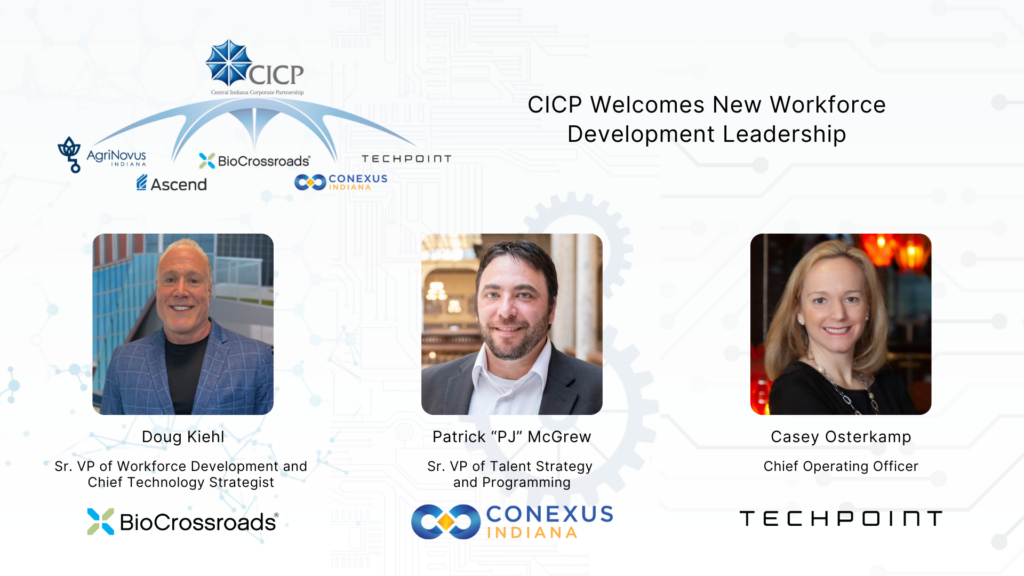
INDIANAPOLIS (December 2024) – The Central Indiana Corporate Partnership (CICP), alongside its branded initiatives BioCrossroads, Conexus Indiana and TechPoint, announces the appointment of three senior leaders who will play pivotal roles in shaping the future of Indiana’s life sciences, advanced manufacturing and logistics and technology sectors.

Douglas Kiehl, Patrick “PJ” McGrew and Casey Osterkamp joined BioCrossroads, Conexus Indiana and TechPoint, respectively, in senior leadership roles on December 10.

“As we ensure the strength of Indiana’s advanced industries, these strategic hires underscore our commitment to building a thriving, innovative economy,” said Melina Kennedy, CEO of the Central Indiana Corporate Partnership. “Doug, PJ and Casey each bring a depth of expertise that will help us tackle workforce challenges, advance technological adoption and foster cross-sector collaboration. Together, they will elevate our efforts to position Indiana as a global leader in innovation and talent development.”

BioCrossroads adds SVP of Workforce Development and Chief Technology Strategist
Douglas Kiehl, BioCrossroads’ new senior vice president of Workforce Development and Chief Technology Strategist brings over three decades of experience at Eli Lilly and Company, serving most recently as senior director leading the Disruptive/Transformative Technologies Team (DT3) and the Digital Twin Center of Excellence. His work focused on digital transformation, automation, extractables/leachables and next-generation bioprocessing.

In his new role, Kiehl will leverage his experience driving multi-stakeholder initiatives to lead BioCrossroads’ workforce development initiatives and contribute to its 10-year strategy to build a skilled talent pool for Indiana’s life sciences and healthcare industries.

“Doug’s extensive experience and passion for forging the adoption of next-generation technologies makes him a tremendous addition to our team,” said Vince Wong, CEO of BioCrossroads. “His leadership will be key in driving our strategic efforts to enhance Indiana’s life sciences and healthcare sectors. By cultivating a skilled workforce and championing adoption of new technologies, Doug will help prepare our workforce for the future and ensure that BioCrossroads continues to support the growth and success of Indiana’s life sciences and healthcare communities.”

Conexus Indiana names SVP of Talent Strategy and Programming
Patrick “PJ” McGrew joins Conexus Indiana as senior vice president of Talent Strategy and Programming. McGrew brings nearly a decade of state government experience, including serving as the inaugural executive director of the Governor’s Workforce Cabinet, where he gained national recognition for his efforts to bridge the education-to-workforce pipeline. His career also includes ten years as a high school teacher in diverse educational settings, with a passion for fostering economic mobility and career exploration for students.

In his new role, McGrew will focus on developing innovative workforce solutions to meet the evolving needs of Indiana’s advanced manufacturing and logistics sectors, further positioning the state as a leader in these industries.

“PJ’s wealth of experience in education and workforce development will be instrumental in addressing the talent challenges facing Indiana’s advanced manufacturing and logistics sectors,” said Fred Cartwright, president and CEO of Conexus Indiana. “His proven ability to bridge the gap between education and industry makes him a great fit for Conexus and we’re excited to have his leadership as we continue to develop forward-thinking talent strategies for our state.”

TechPoint appoints SVP and COO
Casey Osterkamp joins TechPoint as senior vice president and Chief Operating Officer (COO) with a wealth of experience in organizational leadership and talent strategy, most recently as a project consultant at 17a, COO at Herron Classical Schools and concurrently as vice president of Operations at Herron High School.

She is experienced in talent consulting and organizational leadership. In the past, she was the Director of Personnel for the State of Missouri and Director at the Assessment Resource Center. She’s also held consulting positions with IBM and the Harvard Kennedy School of Government. Osterkamp also served as a Surface Warfare Officer in the U.S. Navy.

Osterkamp will work closely with TechPoint’s CEO to lead overall people and operations, to drive more intentional cross-initiative collaborations, and to ensure quality delivery of TechPoint programs and partner enablement strategies.

“We are thrilled to have Casey join our team,” said TechPoint CEO Ting Gootee. “She has a depth of experience that will support TechPoint’s goals and vision to champion and strengthen Indiana’s tech sector.”

These new leaders reflect the CICP’s commitment to fostering innovation, collaboration and workforce development across Indiana’s key economic sectors.

###
About CICP

The Central Indiana Corporate Partnership (CICP) was formed in 1999 to bring together the chief executives of the region’s prominent corporations, foundations and universities in a strategic and collaborative effort dedicated to Indiana’s continued prosperity and growth. To advance this mission, CICP sponsors five key talent and industry sector initiatives, AgriNovus Indiana, Ascend Indiana, BioCrossroads, Conexus Indiana and TechPoint, each of which addresses challenges and opportunities unique to its respective area: agbiosciences, talent and workforce development, life sciences, advanced manufacturing and logistics, and technology. To learn more about CICP, visit www.cicpindiana.com.

About BioCrossroads

Established as a catalyst to advance, grow, and invest in Indiana’s life sciences sector, BioCrossroads is a branded initiative of the Central Indiana Corporate Partnership. It supports the region’s existing enterprises and encourages new business development. The initiative fosters public-private collaboration by uniting a diverse range of academic, industry, and philanthropic stakeholders, all collectively focused on advancing Indiana’s life sciences sector. Committed to supporting the growth of capital investments and talent development, BioCrossroads provides support to both existing and new life sciences enterprises, including the Indiana Health Information Exchange, OrthoWorx, and the Indiana Biosciences Research Institute. BioCrossroads champions the advancement of cutting-edge research and development, plays a crucial role in building and nurturing a robust talent pipeline, and is dedicated to establishing Indiana as a thriving hub for life sciences manufacturing. To learn more about BioCrossroads, visit biocrossroads.com.

About Conexus Indiana
Conexus Indiana, a branded initiative of the Central Indiana Corporate Partnership, is dedicated to advancing the Hoosier State’s position as a global leader in advanced manufacturing and logistics. Working closely with industry, academia, and government partners, Conexus Indiana drives workforce development, economic growth, and innovation across the state. For more information, please visit ConexusIndiana.com.

About TechPoint
TechPoint is the Central Indiana Corporate Partnership’s industry-led growth initiative for Indiana’s digital innovation economy and overall tech ecosystem. The team is focused on working with public, private and industry partners to expand tech talent pipeline, enhance resource connectivity for enterprise organizations and startups alike, and elevate the industry by activating the community and amplifying stories of success. For more information, please visit www.techpoint.org.

+